

EUDR TO BE DELAYED BY A FURTHER YEAR AND BOOKS TO BE PERMANENTLY EXEMPTED.
EUDR will be delayed for a further 12 months till 2027 and will not apply to printed products and books, which comes as a huge relief to the printing and publishing industries.
This press release dated 5th December from European Parliament gave details of the changes to legislation, which were voted into effect two weeks later.
See also this link which gives some further details about which printed products may still be affected.
Printed items that fall under HS code 49, which includes books, newspapers, commercial printing products and advertising material will be exempt. Printed items classified under other HS codes will remain fully covered by the Regulation, for example printed packaging, labels, wallpaper and stationery products covered by HS code 48.
GOMER PRESS EUDR COMPLIANCE STATEMENT (we are leaving this online simply for historical record)
Effective date: 4th November 2025
Gomer Press is committed to responsible and sustainable sourcing and has been for many years. We use only FSC certified papers (C114687), almost exclusively sourced from the EU.
The aim of EUDR is to guarantee that the products EU citizens consume do not contribute to deforestation or forest degradation worldwide. Under the new regulations, when product changes commodity code during a manufacturing process (from paper to books in our case) a DDS (Due Diligence Statement) is required if the goods are to be imported into the European Union. This DDS is generated using an online system called TRACES. There are potentially many thousands of geolocation data points required to accurately report where a book has come from down to individual trees, but that is the aim of the legislation.
In September 2025 the EU Commission proposed delaying EUDR for a further 12 months, but then in October 2025 they changed their minds without explaining how the concerns about systems not being ready have been addressed. As at November 2025 it is still unclear whether implementation will be delayed or simplifications made. Various links here : 3rd November and 5th November and another 5th November suggesting a “delay looks increasingly inevitable”, backed up by this 13th November article. As at 13th November Intergraf (the printing industry association promoting and protecting the interests of the graphic industry at European level) has also called for postponement.
Update 19th November : The dates to watch are 24th–27th November, as Parliament will be discussing both the proposed 12-month delay and the simplification package. The official European Commission communication regarding the proposed delay can be found here.
“Under the Council’s position: the provisions of the EUDR would apply from 30 December 2026 for medium and large operators and 30 June 2027 for micro and small operators”
Although it feels increasingly inevitable that a further delay will happen, Gomer Press are prepared if the regulation does come into force on 30th December 2025.
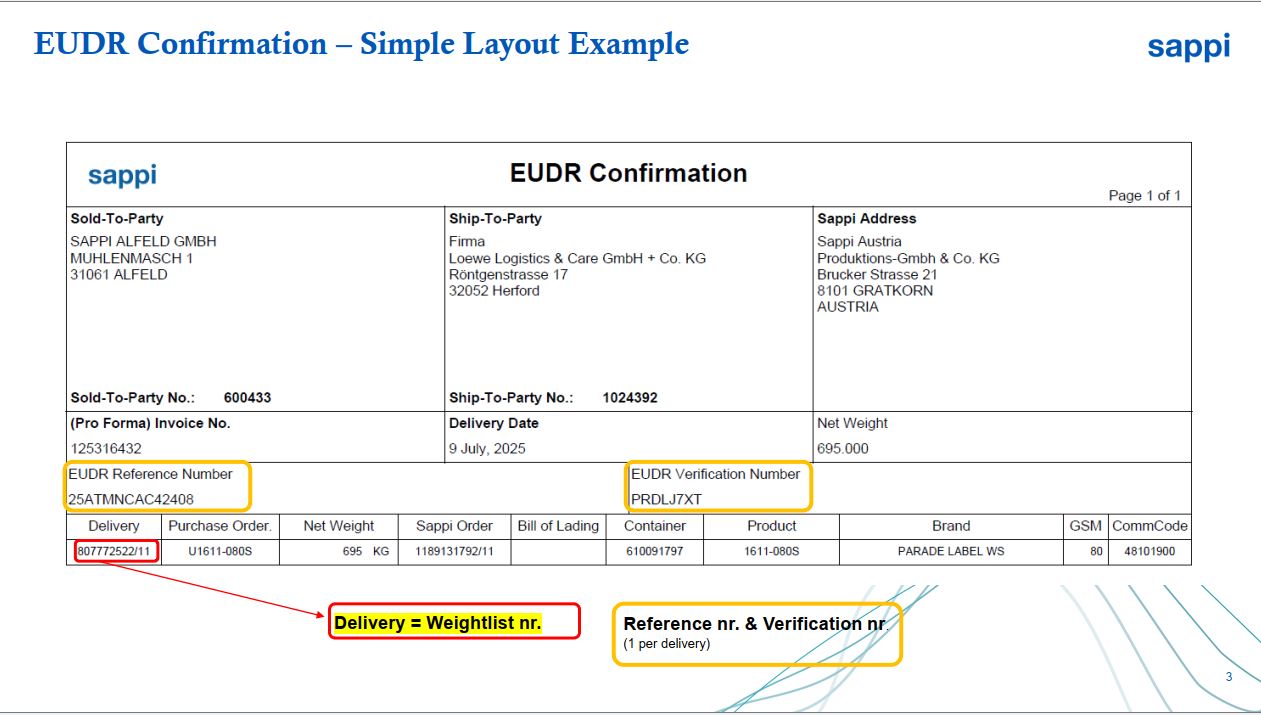
The system being introduced relies on Due Diligence Statements (DDS) which can be traced back through their Reference Numbers (RN) and Verification Numbers (VN) and serve as proof that due diligence has been exercised. Precise geolocation and species data will be held within the TRACES system linked to these reference number.
Every RN and VN provided to Gomer by paper merchants will originate from a Due Diligence Statement submitted upstream into the EU TRACES system. The DDS contains all the information required under EUDR, including geolocation and legality checks. Gomer Press will pass these identifiers to our customers so that they can reference them in their own compliance systems or customs declarations.
It is our understanding that for paper made or books published prior to 2026 a single “transition code” DDS will apply, though this change has yet to be implemented. At the moment the legislation requires data for pre-2026 jobs that do not exist in any manageable form.
Many of our customers are small or micro-businesses (see definitions at the bottom of the page) – independent publishers, authors, and creative companies — and currently it looks like full EUDR requirements will not apply to this type of business, at least initially. All that will be required will be record keeping, and Gomer will supply the relevant data (DDS). Having said this, full EUDR requirements will currently still apply if books are being sold through a large business like Amazon, a large distributor like Gardners or a large bookshop chain like Waterstones!
We will monitor official EUDR and industry guidance and will update our approach as implementation progresses. By working with Gomer Press, you can be confident that your printed products are produced with responsibly sourced materials and meet the requirements of EUDR.
We will do all we can to ensure that this “masterclass in regulatory burden” does not create any more issues for our clients than strictly necessary. As with GPSR we will aim to be able to provide our clients with a solution, in this case export DDS statements ready to go onto customs paperwork or in to retailers like Amazon.
For more information contact : sales@gomer.co.uk. We’re here to answer questions about EUDR compliance
BIC (The book industry’s supply chain organisation) has published useful guidance on it’s website . Their attempts to summarise just go to show the complexity involved.
Follow this link to see the full regulation on the EU website
The below screenshot shows the type of additional data we expect to receive from our suppliers;
And the below shows what we expect to be able to provide our clients, the example below being a simple softback book with two parts – 4pp cover on 250gsm board and text on 150gsm Matt paper;

EUDR definitions of small and microbusinesses; Micro business definition : An enterprise is considered a micro business if it meets at least two of the following conditions: Employees: Fewer than 10 employees. Net turnover: Less than €700,000. Balance sheet total: Less than €350,000.
Small business definition : An enterprise is considered a small business if it meets at least two of the following conditions: Employees: Fewer than 50 employees. Net turnover: Less than €8 million. Balance sheet total: Less than €4 million.